PhD Dissertation Defense
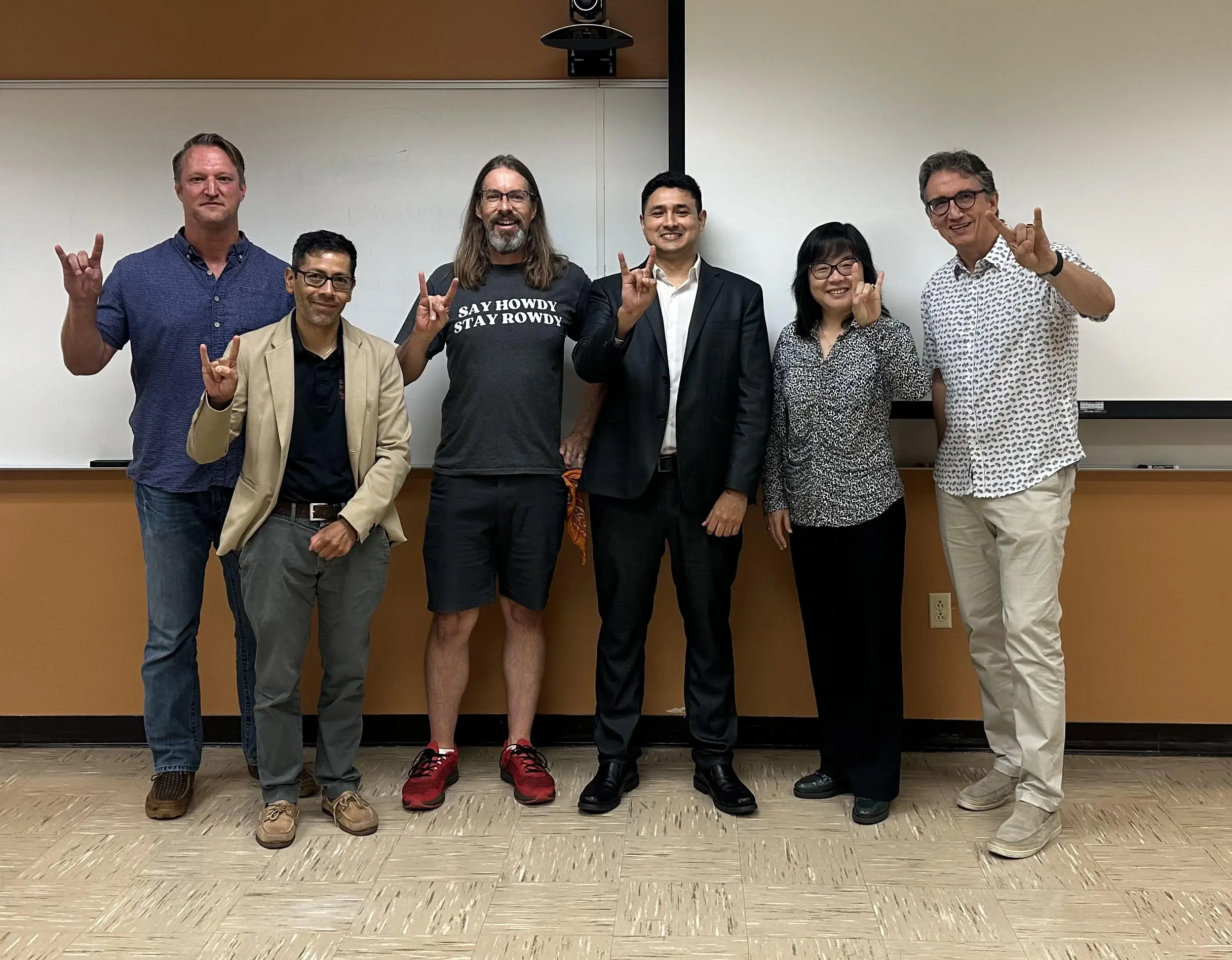
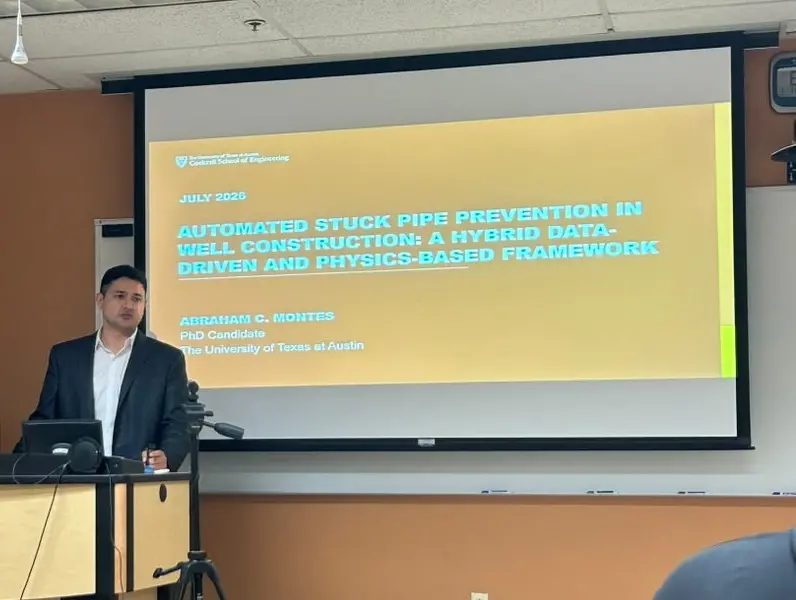
July, 2026.I am thrilled to share that, on July 1, 2026, I successfully defended my doctoral dissertation, "Automated Stuck Pipe Prevention in Well Construction: A Hybrid Data-Driven and Physics-Based Framework." The dissertation comprises six chapters and seven appendices and is centered on three fundamental research questions:
- Can data-driven and physics-based models for hole cleaning, borehole stability, and torque-and-drag be integrated for stuck pipe prediction, thereby addressing the limitations of existing approaches?
- Can casing runnability be accurately assessed in a timely manner while simultaneously indicating where this risk is located and why?
- If a sensor were available, could the volume and morphological characteristics of cuttings and cavings be measured to provide additional data for stuck pipe prediction?
To address these questions, multiple hypotheses are formulated and tested, leading to validated hybrid (physics + AI) modeling frameworks that effectively overcome the limitations of existing approaches to stuck pipe prediction. The abstract of the dissertation is provided below.
Abstract
Stuck pipe incidents have been a persistent challenge since the early days of rotary drilling and remain a major source of non-productive time and substantial financial losses. Effective prevention depends on the timely, accurate, and interpretable assessment of sticking risk. Although numerous methods have been proposed for this purpose, important limitations remain. First, existing approaches often struggle to identify early indications of sticking while maintaining a low rate of false warnings. Second, most methods provide limited insight into the mechanisms driving the risk. Consequently, even when predictions are generated in real time, their interpretation and the selection of appropriate mitigation actions still require significant manual processing, often leading to delayed, biased, and ineffective preventative measures. Third, most approaches are not suitable for assessing the risk of stuck casing in a timely manner, despite its potential to cause even greater losses than drillstring sticking. This application is particularly challenging because effective prevention requires greater anticipation: predictions must be available before running the casing, as casing strings generally lack versatility and allow only limited corrective actions.
This dissertation investigates feature spaces and modeling approaches aimed at overcoming these limitations. Based on the findings, it develops comprehensive solutions for stuck pipe risk assessment capable of recognizing early indications of sticking during drilling, tripping, and casing installation operations. The proposed solutions are designed to be interpretable, providing information not only about the risk of sticking but also about the mechanisms contributing to that risk. To achieve accuracy, interpretability, and applicability across different fields, well designs, and geographic regions, the methods integrate data-driven and physics-based modeling approaches.
The proposed solutions have been constructed and tested using field data, including a field trial of the proposed system for enhanced assessment of hole cleaning sufficiency and borehole stability—two critical factors in evaluating sticking risk. The results demonstrate that the proposed methods effectively address the identified limitations and support incident prevention. Beyond the potential to reduce the financial impact of stuck pipe events, these solutions can also serve as a foundation for fully automated drilling systems, where timely and reliable sticking-risk assessment is essential.
Stay tuned! The complete dissertation will soon become publicly available in the official repository of theses and dissertations of The University of Texas at Austin