
Winner of the SPE Regional Paper Contest
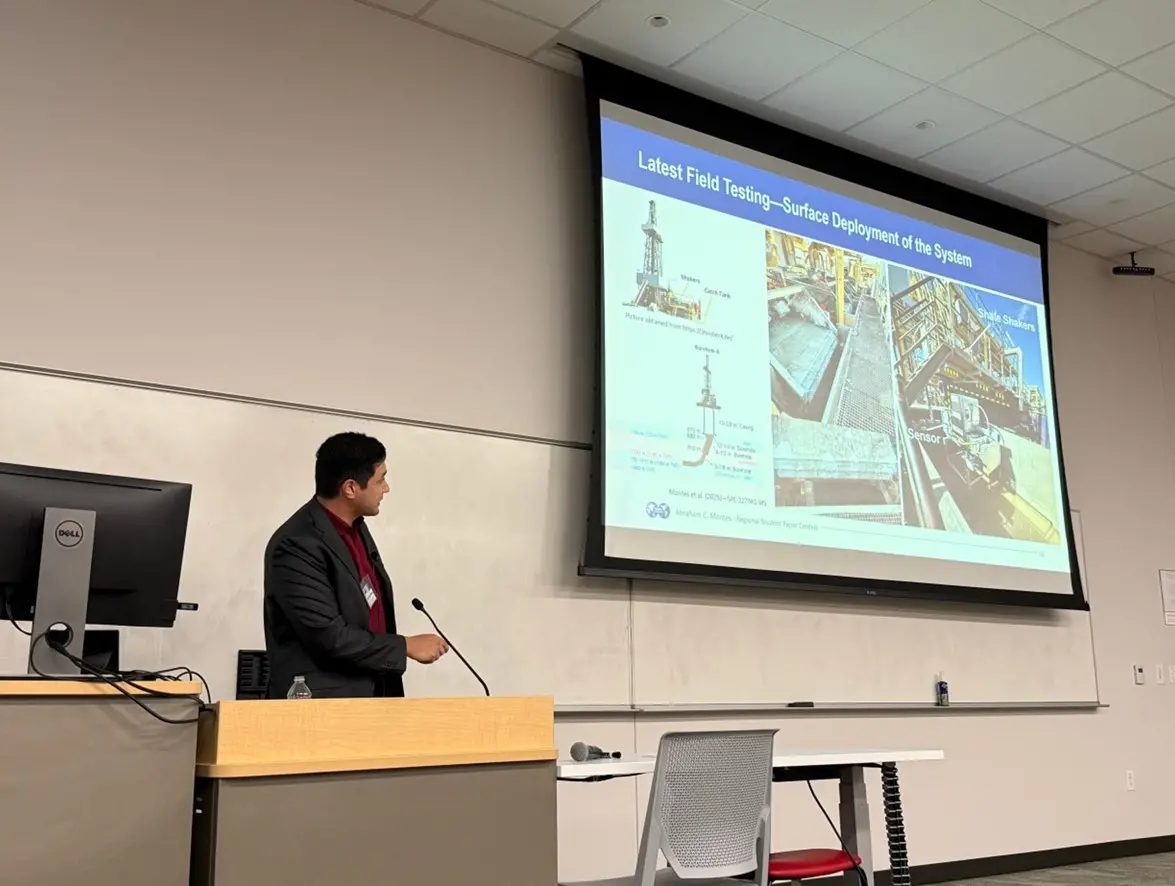
March, 2026.I am thrilled to share that I was awarded first place in both the SPE Local Paper Contest at The University of Texas at Austin and the SPE Gulf Coast North America/Southwestern North America Regional Paper Contest at the University of Houston. As a result, I have earned the opportunity to represent the region at the SPE International Paper Contest, at the upcoming SPE Annual Technical Conference and Exhibition, in Houston. The article presented focuses on hole cleaning automation and presents a novel method that leverages real-time measurements of cuttings and cavings—including their volume and morphology—to help prevent costly stuck pipe incidents. Specifically, it enhances the real-time assessment of the risk of annular pack-off caused by solids accumulation downhole. The abstract is provided below.
Abstract
Existing methods for evaluating hole cleaning and borehole stability during drilling are limited, relying either on model-based predictions (e.g., of cuttings accumulation downhole) with infrequent and often inaccurate surface validation; or on surface measurements of returning solids without support from robust cuttings-transport or borehole-stability models. This paper presents an integrated system that combines advanced physics-based modeling with a state-of-the-art sensor to diagnose borehole instability and insufficient hole cleaning, providing actionable information to help prevent stuck pipe incidents.
The proposed system encompasses three main components. The first is a laser-based sensor that collects 2D and 3D data of the cuttings stream in real time. The second component is a digital tool that uses state-of-the-art artificial intelligence techniques to transform the collected data into information relevant for borehole condition evaluation, such as recovered cuttings volume and size distribution. The third component is a set of physics-based models—for cuttings transport and rock mechanical behavior—that provide a real-time baseline to assess whether there is an excess or deficiency of cuttings recovered at the surface and/or indications of rock failure, thereby supporting the diagnosis of poor hole cleaning or borehole instability.
The system was tested by evaluating hole cleaning conditions in two wells where the sensor was deployed. Two tests were conducted. The first assessed the system by comparing the measured volume of cuttings against the expected volume and contrasting the resulting hole cleaning evaluation with observed drilling conditions (i.e., the presence or absence of stuck pipe indicators). The second involved deploying the integrated digital tool to evaluate its real-time applicability. This case relied on a simulated real-time feed of sensor data into the digital tool and the transmission of results via an application programming interface. The tests demonstrated that the system accurately identified hole cleaning conditions in both wells. They also confirmed that the system components—including the digital tool, which processes sensor data and physics-based simulations—can be deployed together to generate a holistic, real-time assessment of borehole conditions. Furthermore, the system serves as a foundational component for fully automated solutions for hole cleaning and borehole stability management, offering the potential to significantly reduce the occurrence of costly incidents such as stuck pipe and casing run failure.
This work presents the first automatic, fully integrated system capable of providing a comprehensive real-time evaluation of hole cleaning sufficiency. It combines an accurate and direct measurement of cuttings volume with a reliable estimate of the expected volume, thereby supporting stuck pipe prevention. More importantly, the system represents a key advancement toward fully automated hole cleaning and borehole stability management, as well as autonomous drilling—goals that are actively pursued by the drilling industry.